My Pacing Plans: my whole year of 8th Grade Social Studies (U.S. History) in chronological order, and yes… color coded. It just doesn’t all fit in a planbook, so one long page it is! Not saying it’s perfect, but it includes a lot of my go-to links. Is this everything I use? No. I pick and choose and add as I go. And do I stick to this schedule exactly? No.
August- September
Topics: European Exploration, beginning of English colonies
Day 1 Simulation
List of Spanish/early Settlers
2 page map to put into interactive notebooks
Continued influence on current culture in US like languages spoken.
I think of teaching explorers not as lecture but as story time, where we annotated together as we went. Stop to ask common theme questions- seeing a pattern here about what the explorers are looking for (NW Passage, glory, gold, spread religion)
Introduce the idea of the Danger of Single Story Ted Talk. An ongoing theme will be not to learn EVERY story, but to be aware that there is always more than one story, and we will strive to bring awareness. Great theme of the year: Whose story is being told? Whose story is NOT being told?
Assessments: If any, open note quizzes so students start seeing the value of good, clear notes. Quizzes can have level 1 DOK, and connection short essay questions- include choices.
Additional stories/perspectives to consider: 56 million natives die of disease which impacts global climate in 1600s. Continue to highlight differing perspectives and reactions of native populations. Africans are early settlers of the English colonies. Slavery was not new, and was not based on skin color until much later.
Impact and history on the Caribbean.
Explorers versus settlers
Different reactions of native populations so they don’t get the idea of one reaction/group. Very diverse.
Topic: English Settlement: 13 colonies.
10 min Video from Mr. Roughton as preview on lead up to 13 colonies and Revolution:
Begin Cornell Style notes with level 1, 2, 3 DOK questions as we go. Do a lot of modeling. See more about DOK on Social Studies main page
Geography of 13 colonies, 4 regions: New England, Middle, Southern, Backcountry. Maps in notebook to color in.
Intro to Atlantic Slave Trade
Learn about 13 colonies (for project?) Note: slavery was in every colony at some point but suffered over time.
Map interactive http://www.softschools.com/social_studies/13_colonies_map/
World Religions Map interactive pbs
History of Slavery in early colonies for teacher background info (1619 first documented African slaves, first documented slave for life in Americas in 1640).
A caution on overemphasizing 1619
Teaching Tolerance more teacher info
Middle Passage documentary w clips from Roots from Historians clip: 2 min 35 sec
If need extra stuff:
Video: World explorers not just America’s
Can tie in with argument writing:
Roanoke: When starting topic on early English colonies can show this video as the intro. I may have them write what they think happened based on the evidence- kind of like what we have been doing in the Argument writing. They have to refer to the evidence, not just that they hope aliens are among us. 🙂
More Media to include or refer to for background info.
Documentary for teacher background: 1 hour or 1.5 hour verions: Traces of the Trade: A Story from the Deep North by Katrina Browne- traces ancestors of slave traders through triangular trade. Decide on excerpts if show in class this early in the year- might be better later when connecting to today and post-Reconstruction era.
Episodes from “Who do you think you are”: Ashley Judd (Colonial), explains purpose for English emigration. Religious persecution.
Deep- American Experience on Amazon prime. Whaling video. First 13 minutes in talks about Colonies.
Story of us Rebels beginning. First 20 minutes has Jamestown, John Rolfe, Tobacco, Plymouth, etc.- used as preview of next unit. (Has a bit of Roanoke and colony beginnings, too)
What religious freedom really looked like in different colonies. Free to be anything? Or just free to be not Church of England?
Topics: 13 Colonies, Early America before 1763. By mid September
Focus: Colony Geography Maps more in depth, Colony Fair Project if you want. Not always best use of time, but good project with creativity allowed. Assign a colony to each group to design a poster display or video to advertise moving to the colony. Can be set in history or from today. Lots of online stuff about this. I change it every year.
Note: My problem with 13 colony projects: They only touch the surface but take up a lot of time. Have been able to shorten it to 1 week and be due by end of September. Wevideo project in groups. Groups of 3 or 4. Choose some of the colonies- not all 13 must be done. Was good to do group work in September though: discuss with groups about what makes a good team, what do do if people bossy, etc. wording ideas. Explicit group work social skills. How to invite quiet students in with questioning strategies. For loud students: “I noticed you’ve talked a lot but Steve hasn’t. Let’s ask Steve what he thinks.” It’s ok to point out what you are noticing about the group.
Tech to include: Bitable, Powtoon, Screencastify, Wevideo narration. Not your average trifold project please.
Goal for group work: Be responsibly for trying your own strategies and get better each project.
Sample of a 13 colony project example:
Assessments for sure: After colony projects, do 13 colony quiz, location and spelling.
Topic: Early America paving way to American Revolution
French/Indian War: color code map of boundary lines before and after the war, Proclamation Line and impact on settlers in the Backcountry.
Hamilton Musical: Schuyler Sisters to show energy of the time, more about women’s roles. History Has its Eyes On You (re: Washington’s first losses as a general)
Media: Economic theories of taxation. Interesting Wealth Inequity summary: capitalism vs. socialism income slopes. https://www.youtube.com/watch?v=QPKKQnijnsM
October
Topics: Road to American Revolution though signing of U.S. Constitution
Simulation of taxation without representation. Lots of those out there. TCI has a good one.
Main lessons: Close Read Stamp Act Lesson from SHEG, Loyalist/Patriot Debate, Close Read Declaration of Independence and simulation, Capture the Flag simulation of American Revolution: 50% of class is red team/British, 25% blue team/American, 25% white team/French. Half of red team sits out the first few rounds to represent British soldiers who hadn’t arrive to the Americas yet. White team joins in towards the end only. Stack the rules against the red team and make blue team only have to be defensive, expect some of the red team to want to quit when they realize not everyone is playing by the same rules. Constitutional Convention debates- add your own Hamilton in this debate if you use TCI.
Electoral College problems numbers example to make understandable for students Electoral numbers vs. Popular vote numbers.
State (11) State (5) State w 12 electoral college votes
Gore 5 2 11 =Gore wins 18 popular votes
W 6 3 1 =W wins 10 popular votes
11 to W 5 to W 12 to Gore
16 Total to W 12 Total to Gore
W Wins even though Gore wins popular vote.
Also show US population map, current electoral college map, “swing states,” World population stuff, prison population in world- USA highest and many not allowed to vote.
Signer of D. of I.: Whipple, owned slave named Prince Whipple. Two perspectives of a signer of the D. of I. shown in history books.
Connections: 2013 interesting bill on ending slavery in NH
Assessment: Lots of big idea questions, not a lot of date/people questions. Was it inevitable that there would be a war against the British? How did the Americans win a war no one thought they would/could? Question later in the month is essay question based on a choice of a constitutional debate topic they have to summarize.
Media: Teacher background must see: Portsmouth Black Heritage Trail of NH
Finish end of America: Story of Us: Rebels episode, Revolution also good if need to summarize and move on quickly.
Hamilton the Musical: Farmer Refuted song, used close reads of Guns and Ships, Meet Me Inside, Stay Alive to build knowledge of the American Revolution and the major players and strategies. Adds a human touch that is lacking in history textbooks. Yes, I bought Hamilton tickets in NY, bought the soundtrack, all clean versions, instrumentals, and Mixed Tapes. Am buying tickets to see it again. My students buy the music, and try to get tickets, too. I think I’ve paid enough for some leeway on usage rights for my classroom.
Paul Revere School House Rocks: http://www.youtube.com/watch?v=Y6ikO6LMxF4
Declaration of Independence John Adams: http://www.youtube.com/watch?v=nrvpZxMfKaU
Educational clip 10 minutes: http://www.youtube.com/watch?v=Q1El-guPeEo
Loyalist Patriot debate recap: http://www.youtube.com/watch?v=coK_9ZVeufI
November
Topics: Constitution and Catch up
Interactive Constitution resource
Close read of Preamble. Point out how it is organized. 6 main points. Rewrite in short.
Mini project by end of next week: turn back to class and recite Preamble. Use songs to help over next couple weeks. Fun activity that is a good example of a level 1 DOK activity. Scored out of 50 points- I print out small preambles and do a running record as they read it and take points off for um’s, extra words, and starting over. But they can retake. Everyone always passes. Perform a few each day over the next week- breaks it up. School house rocks preamble- http://safeshare.tv/w/uSGcipLOBk
School house rocks preamble with lyrics- http://safeshare.tv/w/PpcgYgtSNn
TCI Constitution study stations
Bill of rights- foldable, hand memory devices, scenario study, quiz, review frequently, hip hop song helps reinforce.
Youtube of hand tricks: https://www.youtube.com/watch?v=LYG_f-y8-VY&spfreload=10
Good idea for 1st amendment discussion- is it appropriate to ask a teacher their religion? Answer- there are plenty cases where you might use the bill of rights as a guide, and not necessarily law- bill of rights protects you from the gov- protects your right from being taken away by gov, so if a gov employee (teacher) says you should be a certain religion, then yes, that violates your first amendment rights. Intention w first amendment was to separate church and state, and not to say something is better than another. So ifnyou ask a gov employee their religion, while they are not obligated to answer, they certainly are allowed to. But as a teacher, I feel if I say I am _____, whether on purpose or not, I feel I may be encouraging that bc my position in the classroom carries weight and might send a subtle message that my beliefs should be followed. It doesn’t mean it’s against the law, but if I choose NOT to tell you, that is my right. Therefore, it is not really an appropriate question, although it is not illegal.
Tinker v Des Moines Supreme Court Case good to review
Consider: First Amendment (protest) comments by Coleman Young, Michigan Senator (D) https://youtu.be/AXT3Km4cRNQ
References black lives matter, civil rights movement, slavery, Declaration of Independence, patriotism.
Media: Please Vote for Me Documentary of an experiment in democracy in a 3rd grade Chinese classroom. Good to use around this time. Point out issues founding fathers wanted to plan into the Constitution to help the process succeed even with potential problems. Freedom of the press. The intention implies people need to be free to decide for themselves, term limits in case it doesn’t go well. Access to the person in office to see what they’re doing, how they’re doing it, and petition them to hear your complaints/support. Transparency important- have to be able to point out faults. Be careful with bribery and other unfair issues. What if only boys could have voted in the 3rd grade classroom? http://www.pbs.org/independentlens/pleasevoteforme/makingof.html
Documentary: Inside North Korea as a contrast to democracy. Discussion question: what are the civilian’s options as response to being able to see, and knowing they are on camera? Do you think they are afraid or just that loyal? Why? Important not to have a black/white answer but be continuing to introduce gray area interpretations for behavior and attitudes toward governments. Take multiple data points into consideration.
December
Topics: First Cabinet (Washington’s Presidency) through Jefferson’s Presidency. French Revolution, Louisiana Purchase, and War of 1812. Burr/Hamilton duel to remind students how human Founding Fathers were.
Close read of One Last Time by Hamilton Musical lyrics compared to Washington’s Farewell Address- Fig tree reference aimed to be more inclusive of religious groups? Use One Last Time singer Chris Jackson interview about performing at White House for Obama by portrait of GW: starts at 1:45 https://www.youtube.com/watch?v=5rLU4vHMnwM
Review Hamilton’s plan as analogy: borrowing money from dad, $1k, pay back $1100 in a year. While you have that money, you lend to others, collect more interest. Build credit suggest, too. Next year, you ask to borrow $2k. What are chances dad will lend you that after you have proven you can pay it back? Helps students learn idea of debt not always being a bad thing. But then… show them our live debt clock. 
Media: Beginning of Hamilton’s America PBS documentary of how it was made. Hamilton songs: What’d I Miss, Cabinet Battle #1, clean verson. Makes more sense now. Also show John Adam’s perspective with Unite or Die episode from HBO miniseries.
Jefferson and Hamilton: http://www.youtube.com/watch?v=notJuFGXQ9w
SHEG Slavery in the Constitution Lesson Give grievance first (1 per pair). Don’t frontload too much. Goal: more student voices than teacher voice. Annotate: what words/phrases tell you what Jefferson thought about slavery. Work with partner and answer the questions 1, 2, and 3. Must agree on answer and take turns answering. Then review together. Pass out back to back quotes copies- 1 per pair. Go over Rutlidge first together. Model restating their ideas and annotating/pararphrasing, drawing arrows to the phrases that give their ideas away. After Rutlidge together, hand out 1 sided page with grid to each student. Help them record first 2-3 people gradually releasing responsibility. Keep suggesting resaying the writing in different ways to better understand it. At end, discuss that people in history are complicated. Your job as historians is to keep an open mind as you come across new information and don’t jump to conclusions about them.
Chapter 10: focus on French Revolution, Louisiana Purchase, and War of 1812. Try to get through all of this by lecture and videos in 3 days- few notes needed- record events as either unifying or dividing events. Some can be both.
French Rev:
http://www.history.com/topics/french-revolution/videos/origins-of-the-french-revolution
10.1:Burr/Hamilton Duel 26:00 to end (51:05) 15 min total: https://www.youtube.com/watch?v=VwFOHnAWZcg
Use numbered heads together game as a unit review
Media: Story of Us: Westward first part only: Westward migration, Lewis and Clark.
8th grade DC trip is $2,000, would be more like $128 back in this time in history ($ comparison)
The Louisiana Purchase from France in 1803 is another U.S. acquisition that’s considered to be one of the largest land deals ever. With a purchase price of just $15 million (or about $233 million in 2011 dollars), the U.S. added some 13 states worth of territories at less than three cents per acre (or less than 42 cents per acre in today’s dollars). With land costs today averaging between $1,000 and $4,000 per acre in the continental U.S., the total value of the Louisiana Purchase is therefore likely to be more than $1.2 trillion. Today, CA land 3k-12k per acre depending on ability to be farmed, irrigation, etc.
Jefferson mini bio- https://youtu.be/uAt1YLP3T34
Read more: 3 Of The Most Lucrative Land Deals In History | Investopedia http://www.investopedia.com/financial-edge/1012/3-of-the-most-lucrative-land-deals-in-history.aspx#ixzz4SffpDEqK
Follow us: Investopedia on Facebook
Louisiana Purchase History.com Videos: Purchase details: http://www.history.com/topics/louisiana-purchase/videos/louisiana-purchase-doubles-size-of-america
exploration details: http://www.history.com/topics/louisiana-purchase/videos/lewis–clark-expedition-charts-new-territory?m=528e394da93ae&s=undefined&f=1&free=false
Story of Us: Westward for LP details: first 12-ish minutes. https://www.youtube.com/watch?v=_jNAQp_eLls
War of 1812- 2 minute clip http://www.youtube.com/watch?v=ibvUUnFzAFg, Funny clip as preview parody: http://youtu.be/w2AfQ5pa59A
What did people eat in the 1800s Ancestry.com blog: https://blogs.ancestry.com/cm/what-was-life-like-200-years-ago/
Battle of Fort McHenry – Francis Scott Key and Star Spangled Banner song w/ lyrics Smithsonian video
Jefferson NPR: Jefferson exhibit with descendant interviews: http://youtu.be/33011JYnTGE
Ch 10- Slavery in the Constitution from SHEG if time. If you do, show NPR video AFTER, not before: Jefferson owning slaves- 5 minute NPR recap of museum exhibit: http://www.npr.org/2012/03/11/148305319/life-at-jeffersons-monticello-as-his-slaves-saw-it
Jefferson Acrostic (did in class 2 days of 15-20 min) as Assessment
War of 1812 4 min clip http://www.history.com/topics/war-of-1812/videos/americans-and-british-face-off-in-war-of-1812
January
Topics: 1800-1844. Growth of Industry (Lowell Mills, Cotton, Erie Canal, immigration impacts/reactions) through Andrew Jackson (impact and reactions of Native Americans)
MLK day videos: http://mlk.discoveryeducation.com/
Timeline of Civil Rights progress in US history: http://www.yummymath.com/wp-content/uploads/CivilRightsProgress-task.pdf
Maya Angelou and Dave Chappelle Iconoclast video around this time to build up discussion and academic conversation modeling, and for diverse voices and ages into the classroom experience, or later in Ch 18. https://www.youtube.com/watch?v=okc6COsgzoE
Ch 11 focus: Mills, Industry, Cotton Picking, Canal, assign explanatory research essay? Or postpone until later
Brainstorm inventions, interchangeable parts, preview Morse code, beginning of episode America Story of Us: Division: (Use beginning for Industrial Revolution, Lowell Mills, First 7 min on Erie Canal , 7:30 -16:30 is Cotton Gin, Slavery, Lowell Mills, power loom, light). Episode America Story of Us: Westward (use end of Westward for steam engine, indust rev: First 12ish minutes: Daniel Boone and Cumberland Gap, Louis and Clark, Donner Party, Texas/Alamo, Davey Crockett killed, CA Gold, Lincoln in wilderness as a boy, Trail of Tears, Mississippi (43 min in) and steamboat.
Intro to Indust Rev 3 min: https://www.youtube.com/watch?v=3Efq-aNBkvc
Morse Code background 5 min: https://www.youtube.com/watch?v=bNoOYeS0gs0
Morse Code practice: https://www.youtube.com/watch?v=_J8YcQETyTw
Raw cotton activity from http://cottonclassroom.com/
Gumboot Dance: Example of secret communication: Gum Boot Dancers in Africa: https://www.youtube.com/watch?v=U0Q51WVrR40, workers rebellions over time not new or unique to US but related
Nat Turner Rebellion 3 min: http://www.history.com/topics/black-history/slavery/videos/nat-turners-rebellion
Obama video speech at Morehouse College:
Missouri Compromise http://www.montereyinstitute.org/courses/AP%20US%20History%20I/course%20files/multimedia/lesson22/lessonp.html?showTopic=2
Andrew Jackson Video and have them take notes on his pros and cons. Then do Hero or Villain Poster assignment. Or a video assignment on same topic.
Andrew Jackson Video (1 of 10, and the rest on YouTube), if you can play the one from the History Channel, I like that one the best as students are stunned by how they portray young Andrew Jackson as not someone who would have likely become president.
February
Topics: Manifest Destiny, War with Mexico, Gold Rush, Immigration, Reform Movements, the Road Leading to the Civil War but not yet the Civil War. (can revisit Gold Rush until later time)
Westward Expansion
Native Americans: photo story before and after acculturation: http://www.radiolab.org/story/photos-before-and-after-carlisle/
America: Story of Us: Westward- start after Lewis and Clark (12 min starts Jedediah Smith)
Manifest Destiny 3 min: https://www.youtube.com/watch?v=YLmUhT9QOlE
Texas Revolution, Show Story of Us Westward a few more minutes (includes good map)
The Alamo:History Channel: the Alamo Deconstructed:
https://www.youtube.com/watch?v=9dxGZhv4u8Y
Ozzy: https://www.youtube.com/watch?v=INnywnGWavw
Ch 13.3: Watch History Channel’s Mexican American War parts 1 through 6 (60 minutes total):
Take notes in 4 square: Causes, People, Events, and Effects. See: TeachersPayTeacher’s powerpoint on this if needed. https://www.youtube.com/watch?v=HjUEBDOOSDM
Mexican Cession Video: (4 min good summary) https://www.youtube.com/watch?v=l6WySJyOCbU
MEDIA: The Latino List from HBO.
Novel tie ins: House on Mango Street by Cisneros.
Land Grab Video- whole class dance: http://www.youtube.com/watch?v=bgt1azJlYVsor safeshare version: http://safeshare.tv/v/bgt1azJlYVs
Schuyler Sisters do America the Beautiful: “Sea to shining sea”: remember what it took to get there https://www.youtube.com/watch?v=CAFhz24DqtE&list=PLP00ZAwHFjSwlz_bm68CazJcydjmSA5Vh&index=44
Jimmy Fallon funny bit: Gadsden Purchase- https://www.youtube.com/watch?v=gn2FzuPyFlY
and Louisiana Purchase included in that video
Immigration, Arts, Reform
Read The Arrival by Shaun Tan aloud- Wordless Picture book for about a week, little every day along side unit learning on immigration Analysis support handout I made to go with it. Point out the difference between the father’s and daughter’s reaction to coming to the new land.
http://www.youtube.com/watch?v=cnMoUm87QIIHudson River Art activity: pick a quote from an author of the time and draw an image in the style of Hudson River art. Show audio recording of Walt Whitman reading his own poetry.
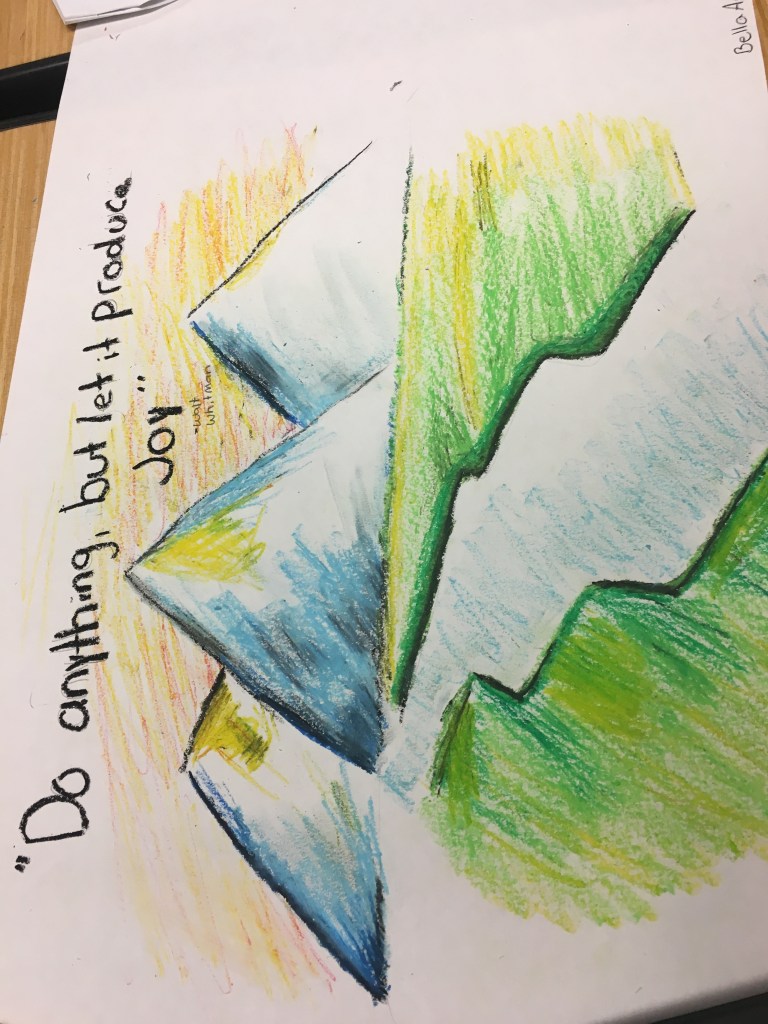
Hudson River School Activity: Show video, have students choose a quote from Whitman, Emerson, Thoreau, or Dickenson (give list of quotes), then students draw a picture inspired by the quote. Write the quote on the page, use pastels, colored chalk, etc. For display. 1 class period. https://www.youtube.com/watch?v=tr8K5qGbydQ (only 3 min- may want to loop it and mute it and put on other music.
Ellis Island: Immigration Through Ellis Island Documentary 28 minutes in length: https://www.youtube.com/watch?v=u4wzVuXPznk
My 2000 Immigration infographic from Museum of Tolerance exhibit: https://photos.app.goo.gl/UN6nbia7Vx3D466P2
Essential Q: How Does Change Occur in our Society?
- · Read aloud title “Reforming American Society”
- What do you imagine that this section is about?
- Discussion
- In your groups for the next 2 minutes brainstorm changes that you would like to occur at the school
- Take 2 minutes to post the ideas on the board
- What do you think Reforming America Society is about now?
Temperance Video 4 min: https://www.youtube.com/watch?v=8u4QDr8WjdU
Suffrage music video 2 min: http://safeshare.tv/v/ss56d89f1274632
1Dorothea Dix: http://safeshare.tv/v/5nvioHrxuq0
Wrap up group question: Which reform movement do you think was most important?
Harriet Tubman: reading excerpt then 8 min mini bio https://www.youtube.com/watch?v=XmsNGrkbHm4
3 min Story of Us clip: https://www.youtube.com/watch?v=Bdno2YLm4Ms
Harriet Tubman Bio – 3 Minutes https://www.youtube.com/watch?v=Bdno2YLm4Ms#t=183
Whippoorwill – 1 Minute https://www.youtube.com/watch?v=jIxfVSS_65o
Where are the leaders today? Model questioning aloud: Is it more difficult to come up with current names? Why/why not?
Harriet Tubman Sentence Expanding: Harriet Tubman helped lead escaped slaves to freedom. (Adding who, where, when, why, how into one sentence to expand and build sentence level analysis/summary fluency.)
North/South Tensions
Simulation on flowers to simulate industry vs slavery. Relates to : Compare Ohio to Kentucky. “river” down middle of classroom. One side is Ohio (free), other side Kentucky (slave). Describe difference in economy/culture/labor when Free is given incentives for each person to cut flowers, pick cotton, etc. and be rewarded with each piece collected. They start to get creative with ideas of how better to do that. Slave side, telling them to pick exactly 50, not one more or less each or don’t get recess time for the week. When focus is not on how to improve how it’s done, just do it. Leads to differing culture.
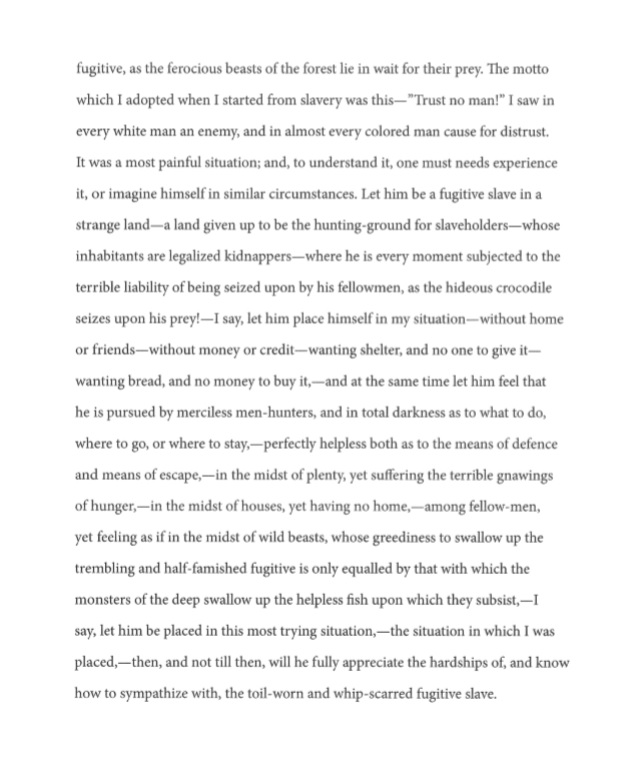
Story of Us Division finish if not all watched already Frederick Douglass Close Read of Narrative Life of FD Excerpt. Review tone vs. mood. Author’s purpose and Tone. Pass out FD to each student. 1)Read silently to yourself. Then give direction to jot down preliminary idea of author’s purpose and tone. 2) read aloud to class me and volunteers. Update author’s tone and purpose. 3) read for unknown words/synonyms. 4) Partners- 1 reads for positive tone words, other for negative. Update author’s tone and purpose on lined paper. If time, 5) read for similes, how does the fig language help him to explain what he doesn’t feel is able to explain. Turn in final author’s tone and purpose. Also discuss. Return dictionaries. 1 hour+ lesson (65-70 min.) Frederick Douglass close read. 1 copy per student. Turn in lined paper and passage when finished. Suggestion for next year or next close read- give them a list of author’s purposes- 5-8 different ones- have them pick using clickers or some other way in the beginning and again in the end… way to assess how much better they understand it after close reading.

Frederick Douglass mini bio: https://www.youtube.com/watch?v=Su-4JBEIhXY
Optional: John Brown Close Read
John Brown clip- goes nicely w/ SHEG John Brown close read
http://www.history.com/topics/john-brown/videos/john-browns-last-speech
Lincoln Agree/Disagree Preview PPT (about 10 min)
SHEG lesson Lincoln SAC- about 60-75 min, can be done in 55 if skip questions page. (Give Doc A,B,C, and D. Read one at a time individually, ask for reactions, then go to next page. If time, have them do the Document questions page from SHEG individually. PPT- 3 min on how to SAC., Assign SAC).
Take notes on the 4 political parties (Whig, Rep, Dem, C.U.P.- project the teacher notes on bottom of mystery cards for them to copy). (about 30 min)
Summarize Dred Scott from his perspective
Media: Watch on Amazon: The Ultimate Guide; Presidents, Season 1, Episode 3. 43 min (first 30?)
March/April
Topics: Civil War and Reconstruction (connecting to the present)
Pre ch 16- civil war trailer from mr. Roughton https://vimeo.com/125822068
Rebel Yell: https://www.youtube.com/watch?v=s6jSqt39vFM
Running questions: what event actually caused the Civil War to start? Do you think the N and S might have a difference of opinion on how it started? Who’s right? Then, what would each side get if they won? Would any of it end slavery based on the beginning of the war? Then how is it that slavery DOES end with this war?
America: Story of Us: Civil War. Pause video to give fatality cards.
-Continue into video and find places to stop and do:
-Listening: Glory Field by Myers Chapter 1 and 2.
-Emancipation Proclamation Close Read from SHEG
-Rebel Yell interruption sometime before intro rebel yell. Enlist help of admin to come in and start yelling and leave randomly.
Music: Buffalo Soldier by Bob Marley as close read in poetry circle- remind them what Buffalo soldiers did after Civil War w/ Native Americans.
Video of 54th Regiment. 5 minutes https://www.youtube.com/watch?v=MSRzOVDjwq0
Abraham Lincoln’s Assassination 122 min total video: Show first 3 min https://www.youtube.com/watch?v=YXyshykSu_0
then around 37 min through 40 min ish. Assassination. Then 47-52ish black American response.
Watch Looking for Lincoln Intro PPT. Do Looking for Lincoln “Who said it?” and video segments lessons from PBS with notes organizer.
Optional Gettysburg video after Looking for Lincoln- brings it into the current time period.
http://www.civilwar.org/education/in4/the-gettysburg-address.html
Reconstruction
Do experiential exercise creating a situation where the rules keep changing for students- they discuss and react to rules changing. They take steps toward or away from how free they feel- how rights are given/taken away. Can be little steps or big steps. Example of road to full citizenship for African Americans historically. Leave open for students to ponder whether they feel full equality has been reached, but continue to pose the question with supporting data.
MEDIA: Slavery by Another Name pbs 90 min or 20 min shortened version about slavery after Civil War- http://video.pbs.org/video/2176766758/
Teacher Background: 13th on Netflix
great timeline activity from edmodo about civil rights events- http://www.yummymath.com/wp-content/uploads/CivilRightsProgress-task.pdf
MEDIA: Watch Blair Underwood Who do you think you are video: http://www.bing.com/videos/search?q=blair+underwood+who+do+you+think+you+are&FORM=VIRE5#view=detail&mid=11CD0A7C684DB800BC1411CD0A7C684DB800BC14
Road to Full Citizenship- Decide beginning and end of a road they draw with symbols along the way. Did African Americans make it to full citizenship? Pairs or individual. No groups of 3. Share out as inside/outside circle like SERP.
6 station research jigsaw or groups from station to station to show connection to current culture in America. Think rotating centers. I change up the artifacts every year. Here’s a list of some of them.
Artifact examples:
http://inequality.org/racial-inequality/
local city laws for students. Curfew.
Diversity statistics in children’s books
Might want to show vocab about prejudice, bias, vs. discrimination
World Pop by country (have link open on computer)
http://www.worldometers.info/world-population/population-by-country/
Nation’s Report Card (education) by state: https://www.nationsreportcard.gov/profiles/stateprofile?chort=2⊂=MAT&sj=AL&sfj=NP&st=AP&year=2017R3
Report on Education vs. Prison per capita spending
compare to Prison Pop by country: http://news.bbc.co.uk/2/shared/spl/hi/uk/06/prisons/html/nn2page1.stm
Earnings by education broken down by gender: https://www.census.gov/content/dam/Census/library/visualizations/2016/comm/cb16-203_graphic_earnings_education.pdf
Maya Angelou vs. Dave Chappelle- Iconoclasts. Skip forward to tail end of his intro (4:18), then skip some: Skip from 13:54 to 16:00. Ended at 28 min in. Example discussion: use of foul language.
http://safeshare.tv/w/xoXDNSLbSt or on Prime episode from series: Iconoclasts
Leads into inside/outside circle debate based on Anne Frank quote: Despite everything, I still believe people are good at heart.
May
Topics: as far as I can get. Some years, did not get very far. Sometimes book walk through the rest of the year to shorten and cram. Sometimes us Story of Us and discussion to tie past further to present. Civil Rights Movement brings them pretty far as it is, so didn’t have too much further to go. I didn’t worry about it much because most of the themes are repeats from earlier in history- industry, immigration, reforms, moving out west, invention, impact on Natives etc., so main theme are still there. 1900s will be covered more in high school, too.
Can conclude with: Suffrage movement as cap on Bill of Rights. TCI has great interactive activities for these later chapters.
Natives today to tie all together. See An Indian Father’s Plea, books by Sherman Alexie and movie: Smoke Signals, novels like: If I Ever Get out of Here by Gansworth (YA Novel), find voices to include in ties to current Native experience in US. Treaties, controversies with gas pipes on native lands.
Great last project idea: choose the most influential event, person, time period, invention, etc., from US history and make a case for it being the most influential. Have done this as a Wevideo project. Include evidence to support your claim, and counter claim, rebuttal, etc. Popular choices were Lincoln, the telegraph, Washington stepping down after 2 terms, the cotton gin, etc. Extension to the project was to imagine you went back in time and changed that one thing, explain how history would have been different, and how our current lives might be different. This one required and improved a lot of evidence and reasoning skills.
Another end of year project: end with Hamilton’s Who Lives Who Dies song. End of year who tells your story? Tell the history of your own life. Tell your own story. Discuss and decide who the audience is, can be, or should be.
I have a lot of documents, etc., but this is my general pacing plan and go-to for links often for my own background knowledge to supplement district provided curriculum. It’s growing all the time.
 Teacheree