Lessons Learned from Distance Learning 1.0

  1. Organize all links on one slide
  2. Variety of entry points
  3. Balance novelty with predictability
Bitmoji Classroom! How many of us are making these to avoid doing something else?

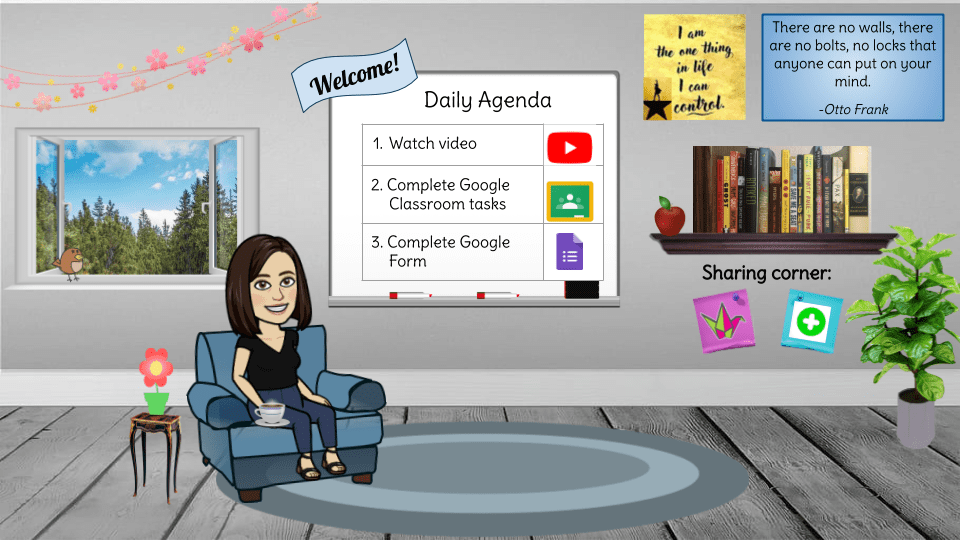
Ok the Bitmoji Classroom wasn’t from the spring. I wanted to make this for the fall. I have no idea how I’m going to use this. I can easily see it getting too busy with too many hyperlinks, but the idea is to have it be as streamlined as possible so I don’t have to change it much every day. Oh well. It was fun to make. And this one is a good visual summary of what DL looked like for me and my 7th grade team last year. Maybe I’ll just use it as my Google Classroom banner.

Intro Video

The YouTube link played a introduction or explanation video. I learned that students treated my video as a commercial. They try to skip it. I even tried to spice it up with music and a little show at the end updating them on the craziness that was two chihuahuas chasing geese they couldn’t win a fight against. It was like a little carrot. If you got all the way through it, you’d have a treat of insanely cute fails! The view count when from 4 per class to 1 or 2 per class, and I’m not convinced it wasn’t counting the time I watched my own video. So I learned: the videos MUST BE SHORT and to the POINT. I am aiming for 2 minutes tops, ideally with screen recordings of the activity to walk those through who need support with executive functioning. I don’t know how DL 2.0 will look with recording myself for asynchronous lessons, but that will be on my mind this year. Short and TO THE POINT! So… not like my blog post today.

Google Classroom Lesson & Activities

The Google Classroom (GC) link will take them to the classwork tab. I like having ONE assignment per day with the title and topic being today’s date. After one week, I reorganize them into one topic called “Past Weeks,” so they are still easy to find with the day as the assignment title. Each assignment will house all the links. Each trimester, I will probably restart on a new GC class to avoid long loading times from packed assignments.

Here’s an example of a day. A morning message, a reminder, the DQ and then all the links they might need to use that day. They answered the DQ in the comment publicly or privately. Most did it publicly. Publically? Hmmm. My spelling is not strong today.

Below is a playlist idea we tried last year. The focus was on engagement and review only. We were learning so much about what distance learning engagement looked like for different learning styles and home environments that we decided variety and choice were key, while balancing predictability. We created a playlist for the week and students could engage with it any way they wanted. The daily question posted in GC was the most popular. We had over 90% participation on some level.
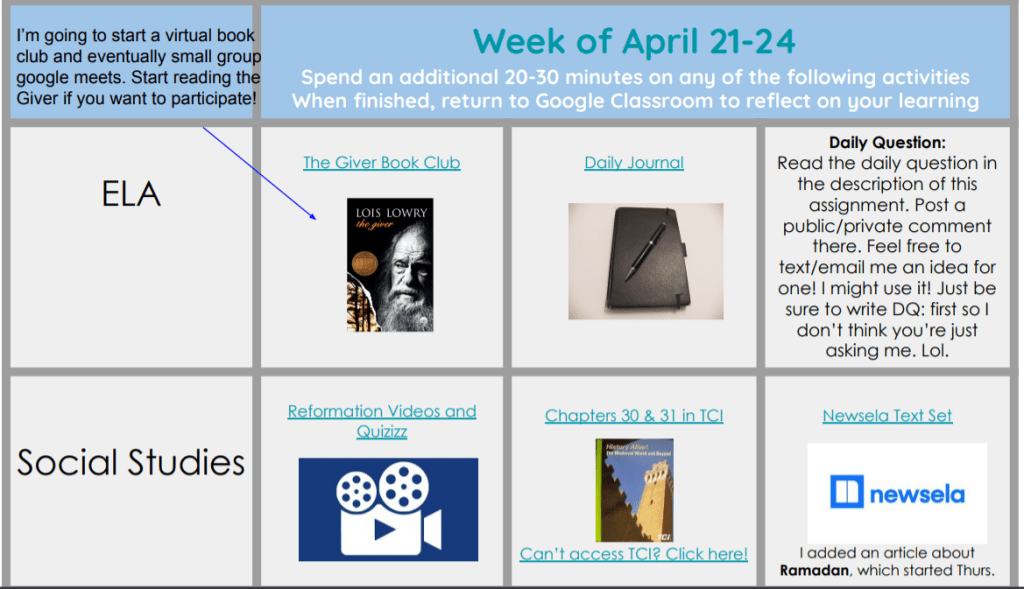
This was shared as a view only google slide with only this slide in it.

Listed here are the various activities in the playlist in order of popularity:

Daily Question: Even students who didn’t engage easily in anything participated in this one. Think of a journal prompt or conversation starter like: Would you rather listen to your family members sing for an hour or dance for an hour? or Does ketchup belong on eggs? (The food questions were the most popular.) Here’s a link to a list of the questions I used. The DQ became a good way to check in with students to see who was still even on a basic level logging in each day. It also helped fill a little of the social-emotional community building bucket as students responded to each other with threads like a monitored version of social media. Only 1 student was inappropriate, and only that one time. My teacher look be fierce even from a distance. I answered the questions, too, or responded to students’ answers. It was fun!

ELA Reading Resources: We used a variety of online literacy programs and these were surprisingly popular. We used articles from NewsELA, CommonLit, and my favorite: ActivelyLearn. I found if I graded the ActivelyLearn activity in real time, students could see other students’ answers and they would request access to revise their answer to make it better. They did that. Without me asking them to. Revision is usually the broccoli of an ELA class, and they just like, asked for more. It was cuckoo bananas bizarre and I loved it. Thank you, ActivelyLearn.org. We also used Freckle, Quill, and Lexia Powerup, but the seemed less enthusiastic about those skill builders.

ELA Quickwrites and short writing tasks: We used NoRedInk’s writing prompts often and the students really engaged in the creative ones. I think what helped was that we copied and pasted their answers into a shared google slide with one student’s work per slide. The next day, we posted it for them to comment or give feedback on each other. Sometimes we posted it anonymously, other times we titled the slide with their name. I think this was another example of students being motivated by publication on some level, because they really did respond to each other. I had one or two private message me that they did not want me to post their work, but I also had a few that would message me that they didn’t see theirs on the slides and did I forget about them. So yes, publishing them was a great idea.

Listening Activities: We alternated reading and listening activities. Students really got into these. The most popular was the StoryCorps shorts that were animated. Shout out to Lila for putting these together!

6 options curated for them to choose from each week, alternating weeks. We used these in class for the Great Thanksgiving Listen (thanks, Heather!) so they were already familiar with them for DL.

We also used the Mars Patel podcast series, and one week we linked 35 Must-Watch TedTalks for Students. That was also a hit. I want to use This Land podcast series for 8th grade social studies, but I’m not sure how yet. Not something I’d want to facilitate distantly as there are mature themes that would benefit from guidance. It’s not one I’d send them off to check out without me.

Book Clubs: We did attempt to offer a book club on the Giver. Many students chose to read the book, but not as many as I would have liked. Those who chose to read it loved it. We gave them two ways to engage: read the PDF or listen to it, then answer some basic comprehension questions. That was the low floor. I had really hoped more would go on to the next step which was to dive into a collaborative google slide show and create a one pager out of their slide or slides. Each student was invited to create and manage their own slide in the slideshow and be able to peak on other students’ as well. I modeled with a video linked on the first slide how they might respond to one another, what kind of questions to pose, etc. Only two or three students even got started with that and then eventually abandoned it. I was so excited about it, too! Oh well. They did however, pose their own questions and wondering to me in the daily google form that I will get to later.

Social Studies

Example of what was linked as an option on one week’s playlist.

We gave them options to watch or read about the content that was in the chapter. Then used NewsELA’s textsets that went with our TCI history textbook. There didn’t seem to be a rhyme or reason to which activities they chose. Many did all of them. I think they were just interested in learning something new. We knew we wouldn’t be able to hold them accountable or expect them to really be responsible for learning it and would revisit what we could the next year, but they really seemed to enjoy learning about the new content.

Quizizz: We also made a Quizizz or Quizlet as some practice and a collaborative, gamified way for them to reengage with the content. I used the test questions from our textbook in the Quizizz so they at least were exposed to the types of questions they should be practicing. This seemed like a success, even though I missed being able to really TEACH it. It served its purpose.

Sharing!

Flipgrid is not awesome for introverts. It’s downright terrifying for some. So while I loved the idea of Flipgrid, I knew I couldn’t force my students to use it. Instead, I treated it as an invitation to share a message. I often gave a prompt to help get them going but it was open ended. Some just started using it as a video diary. Others stalked everyone else but never recorded anything themselves. I say that’s still meeting social-emotional needs. But I learned that Padlet could be a great alternative. So we would share two links. One was to an entire grade level’s Flipgrid so they could “see” each other (whoever felt like it anyway), and would share a link to a Padlet open to the whole grade level as well where they could write messages, or share pictures or memes or inspirational quotes. When both Flipgrid AND Padlet were options, more students participated. It was oil and vinegar. Separate they were deemed unsavory, but together helped kids make a social-emotional salad.

Clientmoji

Seems like a lot

Even going through all this again seems like it should have been more overwhelming than it was. My computer had a LOT of tabs open. Onetab helped, but my screen was still really busy. I knew I had to offer a lot of different options to meet so many different student learning styles and interests to get and keep them engaged, but I also didn’t want to die under a mountain of data collection and tab scanning. Our solution was to create all these amazing activities but only ONE form per week that was recycled each day.

Here’s a link to one of the forms. So we didn’t have to create a new one each day. I used the question eliminator to ask students to self report what they had completed. For example, if a student clicked that they did not read the Giver, it would skip any question that had to do with it, so the form was de-cluttered. This was important, because we were asking them to put 20 minutes per day into Lexia building ELA skills, then spending 20-30 minutes on the Playlist options. The form needed to be basic, and not take too much time or cognitive load.

Workflow aka Organizing the Responses: Since we kept the same link live the whole week to the daily form, it was easy to organize the responses. Each morning, I would open the responses and duplicate the sheet By the end of the week I would have 5 tabs in the sheet. I would then re-title the duplicate with that yesterday’s date. Then go back to the original sheet and delete all the responses from yesterday so you only had the titles of the cells left. It will keep repopulating answers as students fill out that same form today. I also was able to then go to yesterday’s sheet and organize the data by last name to take attendance for that day. Then for anyone who didn’t fill out the form, I would go back over all the other links and DQ to find evidence of them participating on some level. That didn’t actually take that long.

Accountability: Whoever didn’t participate (usually less than 10% did not participate), I would email them directly or send a private comment to them asking how they are doing and that I noticed they hadn’t participated yesterday and if I can be of any help. I did not shame anyone. These were some scary times. There could be so many reasons a student didn’t engage. One student had parents who were both doctors and he had to move in with a cousin. Another had a single mom of 3 who was a nurse. That’s a lot to juggle and manage. Lead with compassion.

Nerdy alert: Once I knew who had participated, then I could start analyzing data and responding to students individually. That part was now made more fun because I could see what they had done or responded to in the form responses, and could target my feedback based on that.

More nerdiness: I also had fun resorting the cells by the last question which was about how they were doing. Anyone who checked the box that they were “loving this” made me a breathe a little easier. And anyone who reported feeling like it was complicated meant I’d reach out to them. Very few ever marked this option. Most said this was working for them. By the end only 1 student said it was complicated, but they had computer issues.

Most extreme nerdiness: I could also sort by who read the Giver, who learned something in social studies, etc. It felt more freeing to be able to get a handle on what they chose all in one place. God, I love excel and sheets.

In Closing… or… What the actual… or… OMG this is EXACTLY like double dutch: I had to go back to relearn the pattern of the ropes so I can jump back in again. OMG it’s SO not double dutch because they keep changing the pattern and how many ropes we have… it’s so not faaiiiiiirrrrr!!! Ok. I mostly wrote this for me because I can’t actually believe what we accomplished this spring. I will be starting at another school this year and was going back through everything to see what 2.0 could look like. Distance Learning 1.0 didn’t end up being as horrible as it could have been. I learned a ton and am much better prepared. Now I’m just trying (like everyone else) to gather as much creativity and ingenuity as I can to analyze what tools are the best to start with, understanding we will continue to learn and reinvent everything as we go. We’ll be ok. We got this (thanks, Cornelius Minor). Get your mantras in order, people. We are going to need them. Mine will be: Oh look at that panicky thought, it’s coming and… it’s going. Good job. Ugh.. why can’t I stop typing? I’m just word vomiting through my fingers now. I’m so sorry. I’m done. For sure. Really.

Clientmoji

Literary Analysis by Annotating a Short Film

For my first video project this year in my 7th grade English Language Arts class, I wanted to integrate text analysis while teaching them how to use WeVideo for the first time.

Leading up to the Project: (make your own copy here, click use template)

Leading up to the project, I had taught the Signposts from Notice and Note Contrast and Contradictions, and the Aha Moment by watching short films (see Notice and Note facebeook group) and discussing and jotting things down, and then just the way it is suggested in the book with “Thank you, Ma’am” short story for CC and excerpts from Crash for Aha and Long Walk excerpt for Tough Questions. My fabulous teaching partner down the hall added this 5-part paragraph structure: define the signpost, identify the stop and ask question, summary, answer the stop & ask question, analyze: explain why it is important. Contact me if you have questions or want me to share any of the docs I used that aren’t on the slides above.

Aha Moment Video Project Directions

CATE 2019 Presentation

CATE 2019 Voices of Literacy in Pursuit of Human Rights

Ca. Assoc. of Teachers of English 2019 Presentation: Moviemaking in the English Classroom

Thank you for attending! So many people! It’s like when someone brings you a latte and you expect a small and get a large: I hadn’t really planned on drinking a large, but yes, yes I will drink the whole thing. While I’ve done a lot with podcasting, this year I chose to focus on my pacing plan of integrating moviemaking into my ELA classroom. Here’s a link to my page about getting started with integrating media projects with a bunch of additional resources. Did I try to do too much in my presentation? Yep. Of course. That’s where excitement will get you.

Contact me if you have questions! I’m happy to help!

The 8th Grade Brain

Some people are cat people. I am not. I am also not a kindergarten person, or 1st, or 5th grade person really, but the real little ones scare me. Imagine a city girl camping in the woods: oh my god! What was that sound!? Is it a monster? No… it’s a kindergartner who just got into the glitter. It’s a for-real glitcident! 

If you’re good with the littles, I’m impressed; we need people like you, but I start sweating when they even walk up to me: are they going to ask me to hold their tissue or something… do they even use tissues?  Some teachers specialize in a content area.  I specialize in 8th grade (ok, I see you 7th graders, you can be my favorite, too!). Thirteen to fourteen year olds, you know, the real smelly ones? They’re my favorite. 

I am fascinated by their brain development, and find them to be like the chihuahua of the dog world because they, too, are perfect. You tell them “no” and they look at you like, “excuse me? Did you just say… NO… to me?”  And I smile. Oh yea, silly me, I meant to say that that was awesome and I give you a brownie point for style, but let’s do more awesome writing and less awesome pencil flipping. Oh, ok, Ms. E., how many brownie points is that now? Oh I think about 15.  Ok. Gets back to work. Later that day my teacher buddy-in-crime tells me she had a strange conversation with one of our students. Now that could mean any number of things: how concerned should I be? She’s shares that the student in question asked her with genuine concern what a brownie point was. Recap: “That means I get 15 brownies at the end of the year, right? Does she bake those or buy them? I don’t get it.” Me: Face palms and giggles with teacher-buddy. Wow, we should totally bake them brownies at the end of the year. (If only we baked.) I wonder what other references I’ve been assuming they get? Prerequisite: you do have to want to understand the age you say is your favorite in order to say they’re your favorite. Lead with curiosity.

Dr. Jay Giedd explains that right before age 13, the brain is adding gray matter: the thinking material. This explains why 5th through 7th graders can be such voracious learners. Then, beginning at age 13, the brain goes through a pruning period, where synapses are being trimmed and consolidated. This doesn’t mean they learn less, just differently. It also leads to them losing about a pound of gray matter every year from age 13 to 18 as their brain pathways rewire.  So if it feels like they are feverishly trying to figure out who they are and who they are not, what they need and what they do not, that’s because they are, by trying to get rid of a pound of inefficient synapses that year, which in my opinion makes them that much more fun to teach- there’s an energy in that. And why it is so important that I provide opportunities for students to make personal connections in the classroom and create meaning in THEIR own ways. It’s their brain they’re using the rest of their life, not yours. 

Teens also tend to take more risks. If they didn’t, Dr. Thomas Armstrong reminds us that if puberty didn’t make us take risks, we would all still be living in a cave, so there is an evolutionary reason to do so. Teens explore. They form bonds with other peers and discover to which tribe they belong, and who they will spend the majority of their adult lives with. So it makes sense that their social lives are a much higher priority than at any other time.  Which is also why it is important that we focus on the social part of social-emotional learning as well. They can’t figure out their tribe without access to a tribe.

Regarding Negative School Culture (which is a real thing so must be capitalized): To the teachers I see who get easily pissed off aggravated by the students they teach, and complain about their students, I want to tell them it’s not the kid’s fault they are behaving that way: it’s brain science, and it might be the teacher, too. Because if you don’t find them amusing, you need to get out! Get out now! Adolescents will not respond well to someone demanding they be compliant, or otherwise not respect the age and stage of development they are in. We need teachers who LOVE the age they teach. If they make you feel icky like I do when a kindergartner (when I’m allowed to be around such littles) asks me to go to the bathroom when I JUST ASKED YOU AND YOU SAID NO, then it’s not the kid, it’s you. Ok? You just haven’t found your kid-breed yet.  Not everyone can be a chihuahua person. 

If you know someone who is a cat person in a dog world, ask them about what they love, and once you get them talking about their passion, pay attention to which age they gravitate towards and gently nudge them into that as if hey, you said it’s your life’s dream: what are you waiting for? Or place subliminal messages all over the staff room of how rewarding that age they said is so maybe they’ll start really considering a change that will be best for everyone… because when you get to teach the age you love, it is magical. 

RIP Bitsy Boo, 2014

Further reading on the sciencee stuff:

Plan for A, B, C, and eek… D

For English Language Arts, I have a… ‘fluid’ pacing plan? Notice my noncommittal single quotation marks. I’m just not going to commit to a plan ahead of time when I don’t know what the room feels like yet. I meet my students where they are. I think on my feet. I teach in the present. So my desk is scattered with the carcasses of butchered lessons. And no, I don’t care. I love my desk. I can’t find it, but I love it.

To that end, I generally have 15 ideas in the back of my mind at any one time, and have lessons prepped for Plan A, ready to change to Plan B, or C, or D, when I walk in, ok sprint in: I tend to run late. (There should be a Family Feud episode between teachers who run late and those other people: the weird morning people. I see you.) Inevitably, something changes and I create something new on the spot that ends up being better than anything I could have planned ahead for anyway. Happy Plan E! It’s just my process, ok!

My sister-in-law, on the other hand, uses the Raley’s e-cart and plans ahead for her entire week of meals. And she doesn’t go back to the store until the following week. Like… she doesn’t forget anything or change her mind and ever have to swing by the store on her way home from work… yeah. Disgusting, I know! How does she know what she wants without walking down the aisles? Some people are Super Mom’s that way. (I hope she never reads this; might make her head too big.) I didn’t get that gene. I used to, ok I still do, run into my mom every other day at the grocery store; we joke that we go there to say howdy to the checkers because we missed them. I guess we just both share a fluid sense of the word “planning ahead.”

Addendum: Upon further reflection, I buy a lot of avocados because they can work for breakfast, lunch, OR dinner. And my favorite shoes are the ones that “go with everything!” I’m noticing a trend. Maybe that’s why I love using poetry so much… it’s the avocado of the language arts classroom: close reading, figurative language, writing, discussion, creativity, critical thinking… *sigh*… so satisfying.

Classroom Management

It’s overwhelming how many ideas there are being marketed out there. There are so many decisions to make. Planning my classroom management has always felt like getting dressed in the morning. Some years are like those mornings when I go through just about every outfit I own, and accessorize heavily, only to give up and go back to those go-to sensible black slacks and top I wore twice already in the last two weeks. My management system is just like that; I know it works, so I go back to it. Yes, I have had adventurous moments: I’ve tried Fred Jones’ Preferred Activity Time (PAT), Whole Brain Teaching (ready, OK!), and a myriad of points systems, but I always ended up back to something more like the sensible black slacks for my management system. It’s not flashy, but it gets the job done. Maybe slacks isn’t the right analogy? Call it the Spanx of my management wardrobe.

I seat students in heterogeneous groups of four; pairs face each other. They are numbered 1-4. Sometimes I name the groups. On my Google Keep to-try-someday list is to theme it up and have Harry Potter houses for groups or historical figures instead of numbering 1-4 (all the Harriet Tubmans, please stand up!) but I will also someday find a red lipstick color that works for all occasions. It just hasn’t happened yet.

While seats are ALWAYS assigned, every class period (oh that’s sweet, child, you want to know if I’m ready to let you choose your seats- you’re so cute! No.), I try to get students out of their seats to move around, whether that’s for poetry circle, or just moving all the 1s and 3s up one group to mix up the pairs. Sometimes I’ll randomly ask students to stand up and have a physical rock/paper/scissors competition or staring contest with a neighbor just for a brain break. It’s super fast, and super random, but it gets oxygen flowing back to their faces… I mean brains. I mean, nobody likes a Ferris Bueller situation, no matter how fun voodoo economics sound. And I don’t care how old your students are, kids who giggle together, learn together, too; it’s like a law in my room.

I tried group points, but I’m frankly just really bad at doing that consistently. I found building relationships and just talking with, not at, my students helps the room feel like we are both getting something out of being there together. I feel like a lot of classroom management strategies for the whole class end up being attempts to “control” the 5% of students that are outliers behaviorally anyway. They don’t need a whole class system. They need you. The best things that have worked for me with these students? Find their “in.”

We all have that one student that I shall name the Pencil Chipmunk who leaves little bits of pencil wood pieces behind while he (usually he) stocks up on angst for the winter of his discontent. You can resupply him daily for a month and still lose that battle as he subtly breaks pencil after pencil to see what will happen. At some point in his history, he’d decided that a worthwhile use of his time was to try to get the teacher to get to the “get off my lawn stage” of irritation. But these cuties are easy to spot, and require a bit of creativity.

For one such pencil-shredder, I triple dog dared him to remember his own pencil the next day, and if he did, I’d do the chicken dance. If not, he’d have to do it. Did he win? Yes. Yes he did. Did I dance with a big grin on my face thinking what is my life? Yes, but I also had fun with it and while he continued to have little issues, it never felt adversarial or purposeful. We had a working relationship, which is worth fighting for. “Don’t MAKE me challenge you to a chicken dance again” became the inside joke that meant knock it off, while letting him save face and me not lose my sense of humor. Once he realized I have a short memory, and don’t overreact to his personality quirks, he felt less judged and safer to maybe be able to grow a little more out of that box of an identity he felt pushed into. If I made it adversarial, the invitation to change over time would have been lost, and we would have been stuck in our roles of behavior problem and behavior enforcer. When you are upset at a 13 year old for not complying, you know you’ve lost your way. Find the “in” that allows you break free of that. The inside joke that allows for a little unclenching of the jaw that is needed in tense situations so you can both breath and not react too quickly. And just be ready for it to look different for everyone.

That’s the A.D.D. quality of teaching well for me. I know I’m teaching well when I don’t have a class anymore, I have individuals who all need me to be a little different at times. Luckily I read a lot, wear strong deodorant, and have pretty walls to stare at after particularly challenging days.